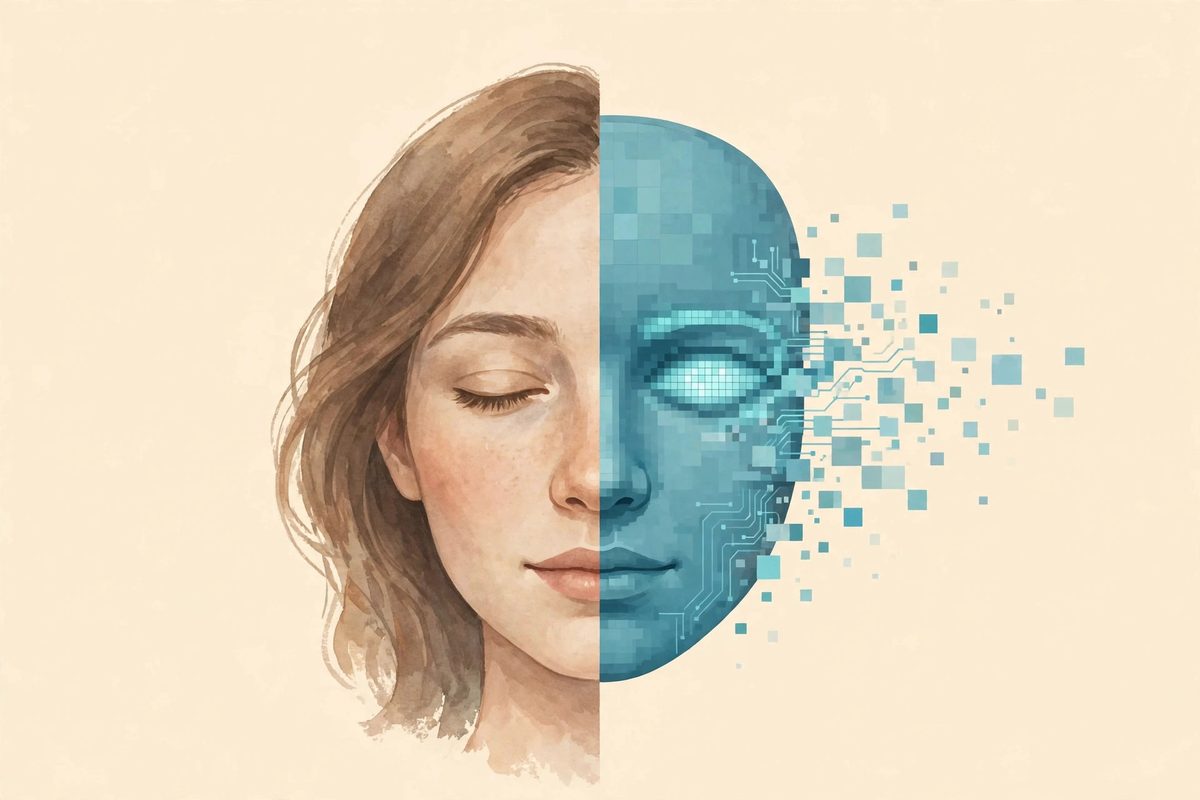
For most of their history, deepfakes were a curiosity with a quality problem: impressive in a demo, wobbly in the wild, and expensive enough that the people most likely to abuse them mostly didn't bother. That era is over. What changed is not one breakthrough model but three curves crossing at once: voice cloning collapsed to seconds of source audio and cents per minute, face-swapping went free, open-source and one-click, and frontier video and voice models — the same generation of tools this site covers as creative products — put near-broadcast synthetic media a subscription away. The result is not that fakes became possible. It is that they became routine: cheap enough to spam, fast enough to run live, and good enough that the weakest link in every scam is no longer the technology. It is the person watching, who still believes their eyes.
What changed: three tiers, all of them lower than you think
Voice is solved. A convincing clone of a person's voice can now be built from as little as 3–30 seconds of audio that is already public — an earnings call, a podcast, a TikTok, a conference talk. Commercial services do it from about a minute of clean audio; free open-source models (the F5-TTS and XTTS families) do it on a laptop; real-time voice conversion — speaking in your own voice and coming out sounding like someone else — runs live, mid-conversation. One vendor benchmark prices a convincing synthetic voice at between one and twenty cents per minute. OpenAI has kept its own Voice Engine, which clones from a 15-second sample, in restricted preview through 2026 specifically because of the abuse risk. When the company that built the tool is afraid of the tool, believe the company.
Pre-recorded video is everywhere. One-way fake video — a "CEO" endorsing an investment platform, a "celebrity" pitching a token — is the industrial form of the technology: no interaction needed, infinitely reusable, and, per the FBI figures below, the single most profitable slice of AI fraud.
Live video is the frontier — narrower, but real. Swapping a face onto a live two-way call is the hardest tier: the leading tools are free and GUI-driven (FaceFusion, Deep-Live-Cam), but sustained interactive deception is still demanding, and confirmed in-the-wild use is concentrated in romance and impersonation scams rather than everywhere at once. Precision matters here: the famous 2024 Arup case — in which a Hong Kong finance worker transferred about $25.6 million after a video call in which every colleague, including the "CFO," was a fake built from public footage, according to Hong Kong police — remains the landmark corporate example, and even there the exact production method was never fully confirmed by a primary source. The honest summary: assume live fakes are possible in any call that matters, not that every call is fake.
What the fakes are being used for
The FBI's IC3 2025 report (published April 2026) broke out AI as its own category for the first time: 22,364 complaints referencing AI, about $893 million in reported losses — roughly 4% of all reported US internet-crime losses, with about $632 million of it in investment fraud (the fake-endorsement videos) and, per AARP-cited breakdowns, some $352 million taken from victims aged 60 and over. The FBI itself says to treat $893 million as a floor, not an estimate. Keep the calibration honest in both directions: AI is not yet behind most fraud — and it is the fastest-scaling part of it, because it removes the fraudster's two oldest constraints, skill and time. Industry trackers report that by July 2026, AI-scam incidents for the year had already passed the full-year 2025 total; one October 2026 vendor analysis (identifAI — a security company, so read its figures as indicators, not gospel) attributes 42.7% of observed deepfake incidents to video synthesis and 21.9% to voice cloning. Deloitte projects generative AI could push US fraud losses toward $40 billion by 2027 — a projection, not a measurement, but the direction is not in dispute.
The playbook has converged into shapes worth recognising on sight:
- The boss who isn't. A voice note, a WhatsApp call, an urgent video meeting: transfer now, tell no one. LastPass caught a deepfake of its own CEO's voice in 2024 precisely because the attempt arrived on the wrong channel — the one detail the process, not the employee's ears, could catch.
- The family emergency. A cloned child's or parent's voice, crying, in trouble, needing money in the next ten minutes. This is the highest-conversion consumer scam because it attacks the one person who will not stop to think: a parent.
- The official. In May 2025 the FBI warned of AI voice and text messages impersonating senior US officials — a reminder that "it sounded exactly like them" is no longer evidence of anything.
- The endorsement. A familiar face, a plausible set, a too-good return. This is where the $632 million lives.
The second danger: real things becoming deniable
Fraud is the loud harm. The quieter one is the liar's dividend: once everyone knows anything can be faked, genuine evidence — a real recording of a real statement, a real video of a real event — can be waved away as "probably AI." The technology's deepest damage may not be that we believe false things, but that we stop being able to agree on true ones. Every defence below matters partly because of this: a world with working provenance is a world where real footage can still prove itself.
Why detection will not save you
It is natural to ask for an app that pronounces "real" or "fake." Resist the comfort. Detectors are trained on yesterday's generators and measurably degrade against models they have never seen; provenance systems are promising but partial. The current state, honestly stated:
- Watermarks (Google's SynthID across its image/video/audio models; Meta's AudioSeal for audio) work only when the generator cooperates. Google lets anyone check for SynthID in the Gemini app and, since May 2026, in Search — but it detects only Google-made content.
- Content Credentials (C2PA) — cryptographically signed provenance metadata, backed by Adobe, Microsoft, Google, Meta, OpenAI, Sony and the BBC — can show how a file was made and edited. OpenAI embeds C2PA in its image outputs and, since May 2026, also embeds SynthID — the first major cross-vendor adoption. But metadata is stripped by a screenshot or a re-upload, and the absence of credentials proves nothing: most of the world's real media carries none.
- Law is arriving, aimed at marking, not mind-reading. The EU AI Act's Article 50 has required, since 2 August 2026, that providers machine-mark synthetic output and that professional publishers disclose deepfakes (tools already on the market have until 2 December 2026), with fines up to €15 million or 3% of global turnover. California's SB 942 has imposed provider-side disclosure duties since 1 January 2026. These rules will make honest content easier to verify. They do nothing to a scammer operating outside them — which is why they are a floor, not a shield.
What actually works
Every defence that has held up in real incidents is a process, not a detector:
- A family code word. Pick one, keep it out of messages and social media, and drill it: any call asking for urgent money must produce it. Ten seconds of setup defeats the highest-conversion scam in the world.
- Call back on a number you already trust. Not the number that called you, not a number in the message — the one in your contacts or on the company's official site. The FBI's own advice for the officials-impersonation campaign was exactly this: verify out-of-band.
- Slow the urgency down. Every deepfake scam is a countdown. A real emergency survives a five-minute verification; a fake one usually doesn't. Treat manufactured time pressure as the tell, not the context.
- Two-person rule for money. No payment, transfer or credential change on the strength of one call or one video meeting — dual sign-off through a second channel. Arup's $25.6 million moved because one person, alone, was convinced by a screen full of colleagues. Process would have stopped it; eyesight didn't.
- Check provenance where it exists. Look for Content Credentials, ask the Gemini app about SynthID, prefer the original source over the re-upload. A positive provenance signal is meaningful; a missing one is neutral — never treat "no watermark found" as proof of fake, or its presence in a detector app as proof of real.
- If you publish: label your own synthetic media. Creators sit on both sides of this. Marking your AI-assisted work (and keeping your originals) is what keeps your real work believable later — and, in the EU and California, increasingly the law.
The tools will keep improving; so will the fakes. The stable ground is not your ability to spot a synthetic face — that ability is expiring — but your habits: verify through a second channel, refuse the countdown, and make "prove it another way" the default response to any screen or speaker asking for something irreversible. Seeing was believing for about a century of photography. That century is over; what replaces it is not cynicism, but procedure.
Sources and classification
Classification: Confirmed News / analysis — a state-of-the-threat explainer; no single news peg. Capability tiers follow published security research roundups; loss figures are the FBI's IC3 2025 report as reported; vendor statistics (identifAI incident shares, synthetic-voice pricing) are flagged in the text as vendor figures; the Deloitte $40B figure is labelled a projection. Checked 9 November 2026.
- WebProNews — identifAI report coverage (incident shares, voice-clone pricing, 2026 incidents passing 2025's total by July; FBI $893M): https://www.webpronews.com/ai-impersonation-campaigns-flood-u-s-companies-with-fake-tools-and-stolen-voices/
- Atlas field guide — "Scams, deepfakes, and social engineering in 2026" (IC3 scoreboard, case table incl. LastPass and the FBI officials campaign, defence layers): https://github.com/laoujin/atlas/blob/HEAD/research/2026-04-28-reframing-the-ai-security-talk-for-a-non-technical-audience/scams-deepfakes-and-social-engineering-in-2026/index.md
- SOTA reference — "Creating Deepfakes in 2026" (capability tiers: voice solved/cheap, one-way video widespread, interactive video narrower; Arup primary-source caveat; open-source tooling): https://github.com/boreilly-dc/sota-reference/blob/HEAD/media-generation/deepfake-creation-models-and-accessibility.md
- Medium (Shah Faisal) — IC3 2025 report figures ($20.877B total; 22,364 AI complaints; $893M; $632M investment fraud): https://medium.com/@sf6782550/how-ai-changing-financial-how-worried-should-be-two-phone-calls-two-very-different-endings-in-3916544c580a
- Debunk.org — "How to Spot AI Images and Deepfakes" (Content Credentials Verify; SynthID checks in Gemini/Search; EU disclosure duty): https://debunk.org/how-to-spot-deepfakes-and-ai-images
- PrismPoster — "EU AI Act Labeling: Creator Guide 2026" (Article 50 duties and dates; California SB 942; industry marking state incl. OpenAI's C2PA + SynthID): https://www.prismposter.com/blog/ai-content-labeling-eu-ai-act-creators-guide
- Legal500 — EU AI Act Article 50 (binding 2 Aug 2026; legacy grace to 2 Dec 2026; marking at model level; detection tools duty): https://www.legal500.com/intelligence/european-union/technology/eu-ai-act-article-50